There are rooms that feel right the moment you walk in. The proportions are satisfying in a way that is difficult to articulate but impossible to ignore. And there are rooms that feel slightly wrong — a ceiling that is too low, a sofa that is too large, furniture that crowds the space or leaves it feeling empty — where something is off without being obviously identifiable.
The principle of proportion is at the heart of this difference. Rooms that feel right are rooms where the relationships between dimensions — height to width, furniture scale to room scale, negative space to occupied space — are in harmony. Rooms that feel wrong are rooms where these relationships are unresolved.
The Golden Ratio
The golden ratio is a mathematical relationship that appears throughout nature and has been used in architecture and design for centuries. It is approximately 1:1.618. A rectangle with these proportions — where the longer side is 1.618 times the shorter side — is considered inherently satisfying to the human eye.
In practice, you do not need to measure rooms or furniture to the precise decimal. What matters is the principle: proportions that are too equal feel static and uninteresting, while proportions that are dramatically unequal feel unstable. The sweet spot — what the golden ratio describes mathematically — is a relationship that feels balanced without being symmetrical.
Applying Proportion to Furniture Arrangement
The most practical application of proportion in interior design is the relationship between furniture height and room height. In a room with standard 2.4-metre ceilings, furniture that sits at a low to mid height — sofas, coffee tables, beds — feels proportionate. Tall bookcases or armoires in the same room can feel oppressive.
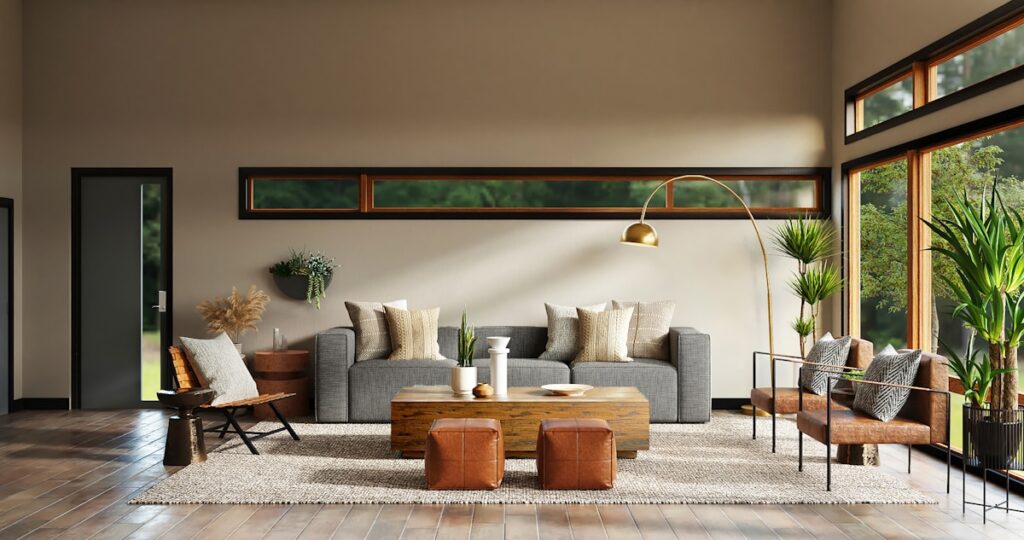
In rooms with higher ceilings — 3 metres or above — taller furniture becomes proportionate and low furniture can feel lost. The architecture of the room sets the proportional register; the furniture should respond to it.
The Rule of Odd Numbers
A related principle is the rule of odd numbers: groupings of three or five objects feel more natural and dynamic than groupings of two or four. This applies to cushions on a sofa, objects on a shelf, pictures on a wall. An even grouping implies symmetry and formality. An odd grouping implies collection and accumulation — a more relaxed and human quality.
This is not an absolute rule. Symmetrical arrangements are appropriate in certain architectural contexts — flanking a fireplace, framing a window. But as a default, odd numbers create more interesting compositions than even ones.
Negative Space
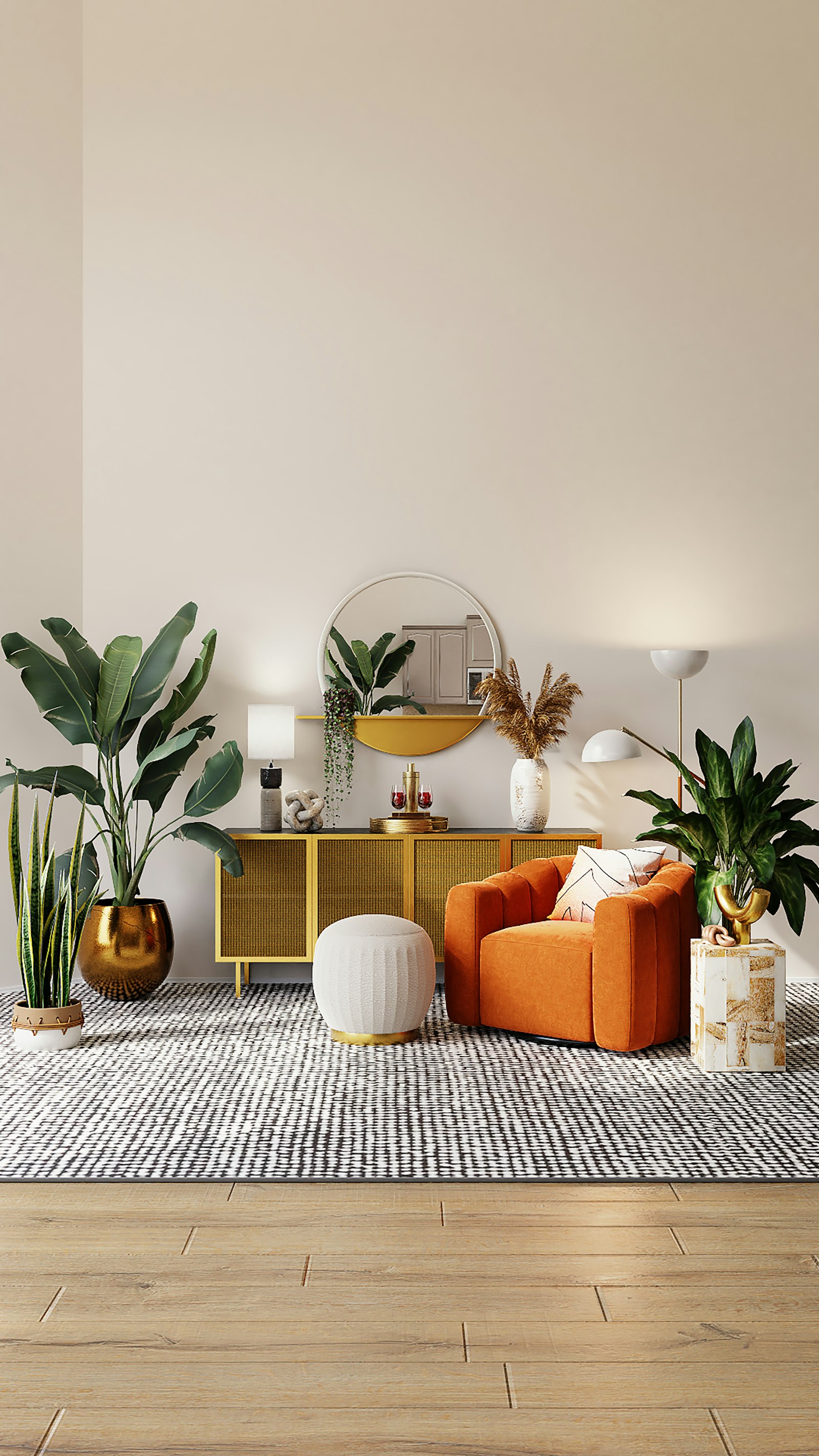
Proportion is as much about empty space as occupied space. A room where every surface is covered and every wall is filled leaves no room for the eye to rest. Negative space — the areas of a room that contain nothing — is not wasted space. It is active. It makes the objects that are present more visible and more considered.
The ratio of occupied to empty space in a well-designed room is typically somewhere around 1:2 — roughly one third of the visual field is occupied, two thirds is open. Rooms that feel too full have reversed this ratio. The cure is almost always to remove things rather than add them.